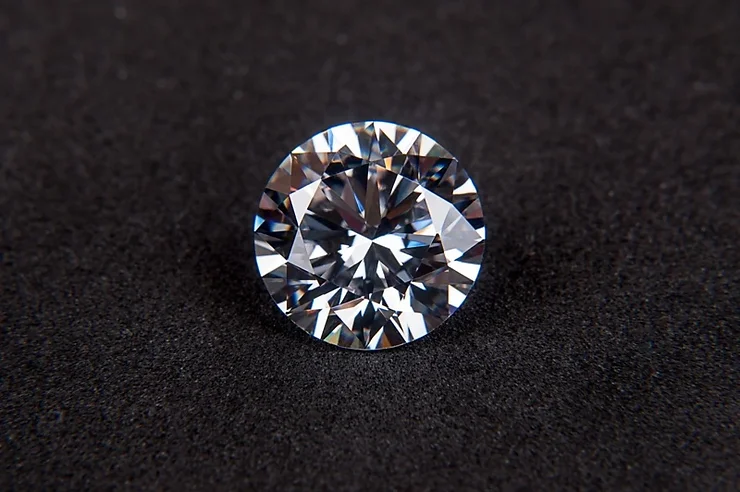
You have inherited a ring containing a clear, sparkling stone. Everyone in the family has always called it a diamond—but is it actually one?
This is a common question when people bring inherited or unworn jewellery to me for redesign. Sometimes there is a receipt or certificate tucked away in a drawer. Often there is nothing beyond a family story and the assumption that a valuable-looking stone must be a diamond.
Before designing something new around an existing stone, it is important to understand what it might be, whether further identification is needed and whether it is suitable for reuse.
CAN YOU TELL WHETHER A DIAMOND IS REAL BY LOOKING AT IT?
Not reliably.
Natural diamonds, laboratory-grown diamonds and diamond simulants can look remarkably similar, particularly when they are small or already mounted in jewellery.
Common diamond simulants include cubic zirconia, moissanite and glass. These are different materials rather than inferior diamonds. Some are attractive, durable gemstones in their own right and may still be worth reusing for sentimental reasons.
A lab-grown diamond is different again. It is a diamond with essentially the same chemical and physical properties as a natural diamond, but it has been created in a laboratory rather than formed within the Earth.
Distinguishing between all these possibilities may require specialist equipment and gemmological expertise.
WHAT DOES “REAL DIAMOND” ACTUALLY MEAN?
The word “real” can create confusion.
Someone may use it to mean:
- A natural diamond formed within the Earth
- A lab-grown diamond rather than a simulant
- Any colourless stone that looks like a diamond
- A valuable gemstone rather than glass or cubic zirconia
A lab-grown diamond is genuinely diamond, but it is not a natural diamond. Moissanite and cubic zirconia are diamond simulants: they can resemble diamond but have different compositions and properties.
When discussing an inherited stone, it is therefore better to ask exactly what the stone is rather than simply whether it is “real”.
DO HOME DIAMOND TESTS WORK?
The internet is full of supposed tricks for identifying diamonds. You may be told to breathe on the stone, drop it into water, shine a torch through it, read printed text through it or see whether it scratches glass.
These tests cannot provide a dependable identification. Their results can be affected by the stone’s shape, setting, cleanliness, temperature and the experience of the person carrying out the test.
The scratch test is particularly unhelpful. It could damage the jewellery or another object and does not establish whether a stone is a natural diamond, lab-grown diamond or another hard material.
Ultraviolet light is not a conclusive test either. Some diamonds fluoresce under ultraviolet light and others do not. Other gemstones and simulants can also show reactions.
If the identity of a stone matters, a collection of home experiments is no substitute for appropriate professional testing.
DOES A HALLMARK PROVE THAT THE STONE IS A DIAMOND?
No. A hallmark relates to the precious metal, not the gemstones set into it.
A gold or platinum hallmark may suggest that the original maker considered the jewellery valuable enough to produce in precious metal, but it does not prove that the stone is a diamond.
Genuine diamonds can be set into silver or unhallmarked jewellery. Cubic zirconia, moissanite and glass can all be set into gold or platinum.
Hallmarks can provide useful information about the metal, assay office and sometimes the age of a piece, but the stone must be considered separately.
WHAT ABOUT A DIAMOND TESTER?
Handheld diamond testers can be useful screening tools, particularly for distinguishing many diamonds from common simulants. However, they have limitations and their results need to be interpreted correctly.
Different testers use different methods and not every device can reliably distinguish between natural diamonds, lab-grown diamonds and moissanite. The size, cleanliness, temperature and setting of a stone can also affect testing.
A basic tester result is therefore not the same as a formal gemstone identification or grading report.
Only a suitably qualified gemologist or specialist gemmological laboratory can provide a definitive identification when one is required.
CAN A CERTIFICATE HELP?
If you have paperwork relating to the stone, bring it with the jewellery.
A report from a recognised gemmological laboratory may identify whether the stone is a natural or laboratory-grown diamond and provide information about its characteristics. The report number may also be recorded in a microscopic inscription on the diamond.
Documentation still needs to match the stone in front of you. Old receipts, insurance schedules and handwritten family notes can provide useful clues, but they are not necessarily proof of identity.
I am not a gemologist and do not provide gemstone certification, grading or valuations. If formal identification or valuation is necessary, I will recommend that this is obtained from an appropriately qualified professional before the redesign proceeds.
WHY DOES THE STONE’S IDENTITY MATTER FOR A REDESIGN?
Different gemstones respond differently to heat, pressure, chemicals and cleaning processes. A method that is safe for one stone may damage another.
The stone’s hardness, toughness, condition and any previous treatments can also affect the type of setting that is appropriate.
Identification may also influence decisions about insurance, specialist setting work and whether the cost of a particular redesign is sensible.
This does not mean that a stone must be financially valuable to be reused. A piece of glass from a much-loved grandmother’s ring may have far greater personal importance than a newly purchased diamond.
The purpose of identifying the material is to make informed decisions and avoid damage—not to decide whether the jewellery deserves to be treasured.
WHAT HAPPENS WHEN YOU BRING JEWELLERY FOR REDESIGN?
I begin by looking at the complete piece: the condition of the metal, the construction of the setting and the apparent condition, size and shape of the stones.
As a jewellery designer and maker, I can explain what may be technically possible from a making and setting perspective. However, this initial assessment is not a formal gemstone identification or valuation.
If the proposed design depends upon a stone being a natural diamond, or if there is uncertainty that could affect the work, specialist identification may be needed before I begin.
Once we understand what can safely be reused, we can explore the design possibilities. The stone might remain the main feature, be combined with other family gemstones or become a smaller detail within something entirely new.
WHAT IF THE STONE ISN’T A DIAMOND?
That does not mean the redesign has to stop.
Moissanite, cubic zirconia, white sapphire, colourless topaz and even glass can all carry sentimental importance. Provided the material is suitable and in good enough condition, it may still be possible to incorporate it into a new piece.
If the existing stone cannot safely be reused, we can discuss replacing it while retaining other elements of the original jewellery. The metal, surrounding stones or details from the original design may still provide a physical connection to the person who wore it.
WOULD YOU LIKE TO REDESIGN AN UNKNOWN OR INHERITED STONE?
If you have inherited jewellery containing a stone you know little about, you do not need to identify it yourself before contacting me.
Bring the complete piece along with any certificates, receipts, valuations or family information you have. I can assess the jewellery from a maker’s perspective, explain what information we still need and help you decide on the sensible next step.
Whether the stone turns out to be a natural diamond, a lab-grown diamond, another gemstone or something valued purely for its memories, we can consider whether it can become part of a piece you will genuinely wear.